One page, one match.
We’ll stay with the club final from the doubles service order story. Aarav Shah and Vihaan Patel, seeded 1, play Arjun Mehta and Kabir Rao, seeded 2, on Court 1. Aarav and Vihaan win 21–19, 22–20. Along the way, Kabir is warned and then faulted for delaying play, and Arjun and Kabir lose a line-call challenge.
The sheet has four parts. The match details and team boxes sit across the top. Below them are six scoring blocks. Each game starts in a fresh block, and a long game can carry on into the next one. Each block has four rows: the first pair in white, the second pair shaded. Notes and signatures go at the bottom.
The BWF’s Instructions to Technical Officials (ITTO) ask for only a few things on paper, but they’re the ones that matter. The umpire gets the sheet before going on court and lines the players up in the order their names appear on it (ITTO 5.1.1 and 5.1.5). The umpire writes the love-all and the first server and receiver (5.2.2.2), and notes the time just before calling “Play” (5.3.3). During the match, the umpire records each score before calling it (5.4.2), and records any misconduct and the action taken (5.17.2). Everything else on the page helps the umpire do those jobs and helps the referee read the match afterwards.
Match details: fill them in before you walk on.
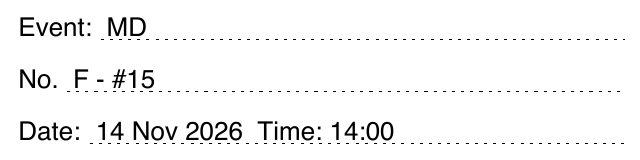
Event takes the short code (MD for men’s doubles). No. gives the round and the match number from the schedule, here F (the final) and #15, so the referee can match the sheet to the draw. Date and Time are when the match was scheduled.
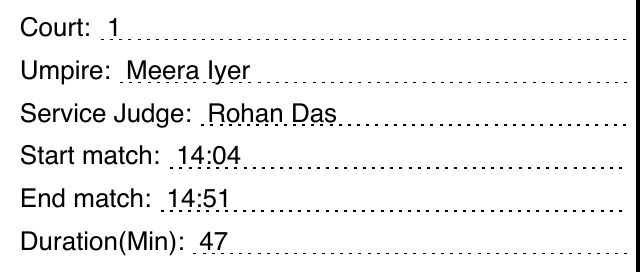
On the right, write the court, the umpire and the service judge. Start match is the time just before “Play”, not when the players walked on. Fill in End match after the last rally. Duration is the minutes between the two: 14:04 to 14:51 is 47.
Team boxes, ends and the score box.
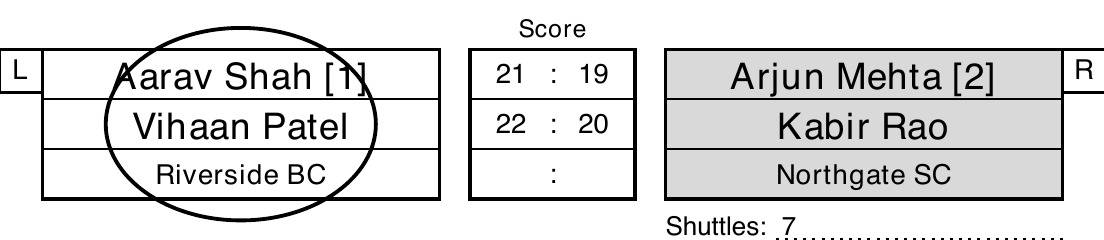
Each pair gets a box: names on the first two lines, club or association on the third. The white box matches the white rows in the scoring blocks, and the shaded box matches the shaded rows.
The small square beside each box records the end the pair started at, L or R as seen from the umpire’s chair. Write it after the toss. When ends change between games, look back at this square to check that the players are at the right end.
The score box takes one line per game. Copy each game score across when the game ends, then circle the winning pair’s box when the match is over. Shuttles counts the shuttles used in the match.
Love all: S, R and the running score.
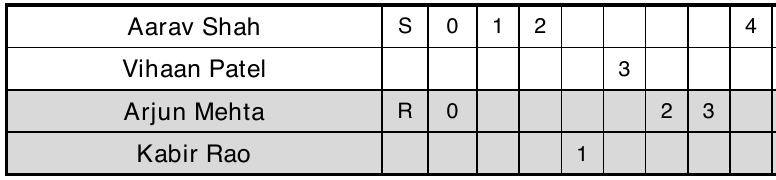
Before play starts, write S beside the server and, in doubles, R beside the receiver. Then write 0 for both sides in the next column. That’s the love-all.
After that, every rally gets its own column. Write only the new score of the pair that won the rally, and write it in the row of the player who will serve next. The losing pair’s score doesn’t change, so their column stays empty.
Follow the opening. Aarav and Vihaan win twice, and both scores go in Aarav’s row because he keeps serving. Arjun and Kabir win the next rally. Their score is odd, so the serve comes from the left, where Kabir is standing, and the 1 goes in Kabir’s row. When Aarav and Vihaan win the serve back at 3–1, the 3 goes in Vihaan’s row.
The row of the last score written always shows you who serves next. If you know how the service order works, a score in the wrong row stands out immediately. In singles, use one row for each player and the same method.
Cards and incidents get their own column.
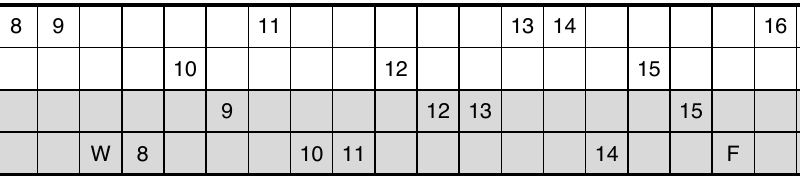
An incident takes a column of its own, in the row of the player involved. At 9–7, Kabir is warned for delaying play, so a W goes in his row straight after the 9. He delays play again at 15–15 and gets a red card. A fault for misconduct gives the rally to the other side, so write F in Kabir’s row first, then 16 for Aarav and Vihaan in the next column.
Explain every mark under the grid: who, what for, which game and the score.
These are the marks SmashIQ’s sheet uses. Some associations have their own keys, so if your referee issues a different one, use theirs.
SmashIQ’s sheet doesn’t mark line-call challenges in the grid. It lists them under it, as in the example: “Challenge lost, Arjun Mehta / Kabir Rao, Game 2, 15–14.”
Deuce and the end of a game.
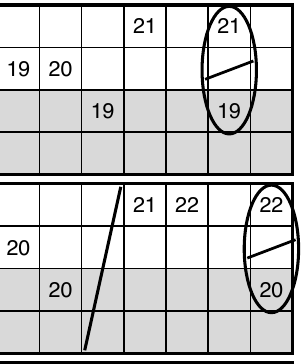
At 20-all, draw a diagonal line through the next column. Anyone reading the sheet can see where the game went to setting, and that the next two points decided it.
When a game ends, leave one column empty. Then write the final score again in the column after it, both sides, and circle it with a slash between the two numbers. Copy it to the score box. Start the next game in a fresh block, with a new S, R and love-all.
A long game may not fit in one block. Carry on in the next block. If the sheet runs out of columns, draw an arrow to the circled final score.
From 4 January 2027, version 6.0 of the BWF Laws moves games to 15 points, with setting at 14-all and a cap at 21. The line then goes after 14-all instead. Everything else on the sheet stays the same.
After the match: notes, times and signatures.

Before the players leave, fill in the end time and the duration, count the shuttles, and complete the notes. A referee reading the sheet a week later should understand every mark without asking you. Sign it, then hand it to the referee. Any red or black card needs the referee anyway, and the sheet is the record the referee works from.
With SmashIQ, the sheet is filled in for you.
On a SmashIQ scoring pad, the umpire awards rallies, cards, challenges and stoppages as they happen. Every rally is captured in order. The sheet is produced from that record, using the same layout as the paper sheet. It includes S and R, each score in the next server’s row, the W and F columns, the line at 20-all, the circled game scores, the times, the shuttle count and the notes.
From the Matches page, organisers, referees and operations staff can open one match’s sheet or download a PDF of every match in the current filter. Before play, you get a blank sheet with the players’ names already filled in. After the match, you get the completed record, and it stays available after the tournament is archived. If the referee corrects a result, the sheet prints the official score, leaves the grid blank and says why, so the page never shows two different matches.
The worked example in this story was filled in that way. If your association keeps paper records, you can archive these sheets without asking an umpire to copy a match out by hand.
Practise on a match you’re watching.
- Print the blank sheet. Score a doubles match at your club, or one on a stream. Doubles is the better test, because every score has to go in the right row.
- Check yourself at every change of serve. Before the next serve, look at the row of the last score you wrote. That player should be walking to the service line.
- Compare with the worked example. Open the example sheet and check your love-all, a W, an F, the line at 20-all and a circled game end against it.